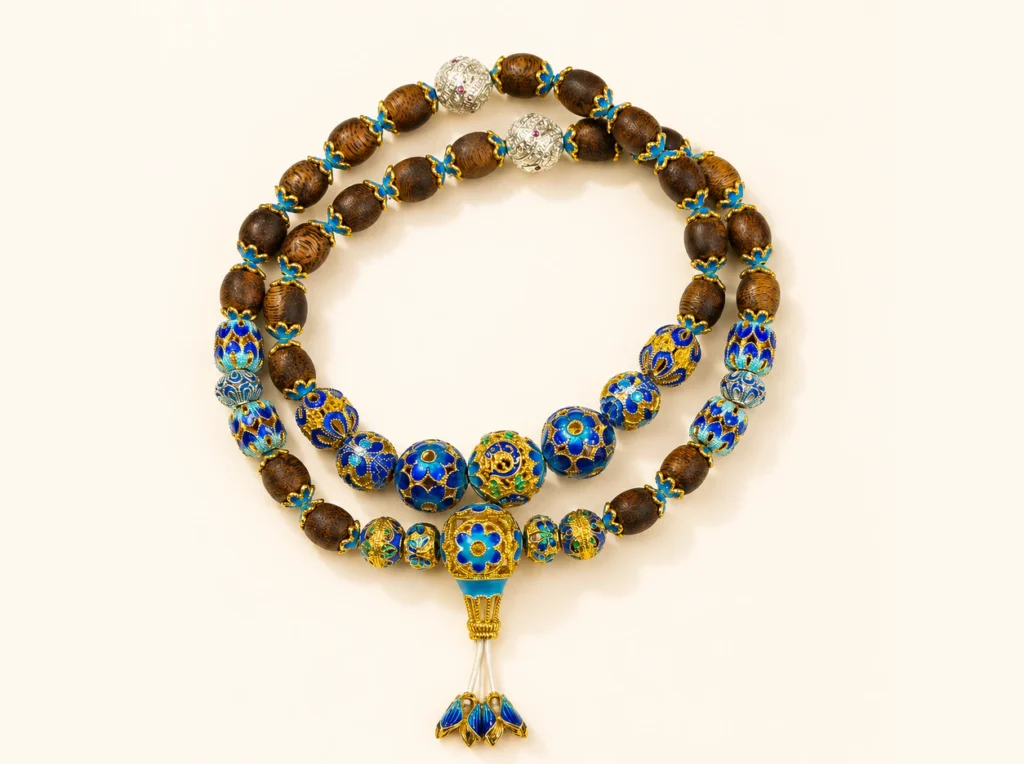
A bracelet gift note needs only three things: a detail you genuinely noticed, a plain explanation of why you chose the piece, and a wish that leaves the recipient free to make it their own. Write two or three sentences in your usual voice, rather than borrowing the language of a jewelry advertisement.
The card is not there to prove that the gift is important. It gives the person opening the box something the product page cannot: your reason for thinking of them. Here is a small writing workshop, with draft lines, edits, and a reusable structure. The examples are suggested wording, not messages from customers.
Start with a detail, not a declaration
Before you write on the card, finish this sentence on a spare sheet of paper: “I thought of you because…” Do not try to sound profound. A shared lunch, an opinion they stood by, or the color they always choose is enough, provided it is true.
Compare these openings:
- Before: “For an extraordinary person who deserves extraordinary things.”
- After: “I thought of the green scarf you wear every autumn.”
The first could accompany almost any present. The second belongs to a particular relationship. It also gives you somewhere to go next: explain what connected that detail to the bracelet. If the connection is simply that you liked the design and thought they would too, say that.
Do not invent a shared memory to make the note more impressive. A small, accurate observation is better than an elaborate story that does not quite sound like you.
A three-line bracelet gift note, with room to edit
Line one: name what you noticed
Try “You have always had an eye for…” or “I kept thinking about…” and complete it with something specific. Avoid telling someone what kind of person they must be. You are offering your view of them, not assigning them a role.
Line two: explain the choice
Keep this line close to your actual decision. “I liked the combination of wood and enamel” is more useful than “Every element embodies your remarkable journey.” If you chose a piece because its name caught your attention, make that your reason rather than claiming the design has a universal meaning.
Line three: leave an open ending
A good final line does not set conditions. “I hope you enjoy wearing it in your own way” asks less of the recipient than “Wear this every day and remember everything you have overcome.” The bracelet is a gift, not an instruction.
“I thought of the colors you always come back to. I liked the wood and enamel together, and wanted you to have something I had chosen just for you. I hope you enjoy making it part of your own wardrobe.”
Use that structure, not necessarily those words. Read it aloud once. If a phrase sounds like something you would never say across a table, replace it.
Three draft cards and the choices behind them
For a shared occasion
“I wanted to mark this year with something you could keep wearing. This piece caught my eye, and I kept coming back to it. Thank you for all the ordinary days we have shared.”
This version names the occasion without trying to summarize an entire relationship. Replace “this year” with a real date or event if that feels more natural. The last sentence is deliberately ordinary: you do not need to turn the card into a speech.
For someone whose taste you know well
“You were the first person I wanted to show this to. I liked its mix of materials and thought you might, too. I will be interested to see what you wear it with.”
The invitation here is conversational. It leaves space for the recipient’s taste rather than announcing that you have found their perfect piece. Only use the first sentence if it is true; otherwise, start with the second.
When the product name is the connection
“The name ‘Together, Still You’ made me think of us. I liked that thought, and wanted to give you something you could wear your own way. With love.”
Together, Still You is a real piece in the collection. The interpretation in this sample note belongs to the giver. It is not a claim about what every wearer should find in the design. That distinction keeps the message personal.
Describe the material without copying the sales page
If the recipient has not encountered wearable scent before, one factual sentence may be helpful. “The beads are cultivated agarwood, paired with enamel” is enough for the card. For a fuller introduction, our guide to olfactory jewelry explains the category.
You do not need to put a price, a material ranking, or a technical specification into the message. Those details belong in the buying conversation, not in a sentence meant for someone opening a gift. Nor should you promise that the bracelet will change how they feel. Describe what you chose, not an outcome you expect it to deliver.
A useful editing question is: does this sentence tell them why I thought of them, or does it simply repeat a product description? Keep the former. Cut most of the latter.
Keep practical information on a separate slip
Care instructions matter, but they do not have to interrupt the personal message. Put the relevant link on a separate note, or send it after the gift has been opened. Our product care page gives the recipient somewhere to return when they need it.
The same separation works before the gift arrives. Patina Aura bracelets are made by hand after an order is placed. If the occasion comes before the bracelet does, write honestly: “I have chosen your gift, and it is being made.” Do not promise an arrival date you have not confirmed.
There is no need to apologize with a long explanation. A clear sentence tells the recipient what is happening; the personal part of the note can remain about them.
The last edit: remove the obligation
Before you sign, look for demands hidden inside affectionate language. “Never take it off,” “Think of me whenever you wear it,” and “This is who you really are” may be more than you mean to ask. Try “I hope you like it,” or simply end with their name and yours.
Then check the details. Is the memory accurate? Is the product name spelled correctly? Have you left out private information that the recipient would not want read aloud? A gift note can be intimate without disclosing anything sensitive.
Short FAQ
How long should the note be?
Two or three sentences are a useful starting point. Add more only if you have something specific to say, not because the gift seems to require a longer message.
Should I explain the bracelet’s symbolism?
Explain your own association if it matters to the gift. Phrase it as “This made me think of…” rather than presenting your interpretation as a fixed meaning.
Can I just write one line?
Yes. “I saw this and thought of you” can be sufficient when it is genuinely what happened. Sign it in your own voice and let the gift do the rest.